
The Great Tech Shift: Why Global Capability Centers (GCCs) Are Quietly Replacing India’s IT Services Giants
For more than three decades, India’s economic and professional narrative was proudly dominated by the undisputed giants of the IT services sector. Household names like Tata Consultancy Services (TCS), Infosys, and Wipro served as the primary engines of white-collar employment, absorbing hundreds of thousands of engineering, finance, and business graduates year after year. For generations of Indian tech workers, landing a role at a premier third-party IT vendor was the ultimate benchmark of corporate stability and middle-class upward mobility.
But look closely at the macroeconomic data today, and you will see a massive, structural tectonic shift that is redefining the entire landscape of India Inc.
According to consolidated industry reports from NASSCOM and Zinnov, Global Capability Centers (GCCs) have outpaced the traditional IT services sector in net hiring for the third consecutive financial year. The gap has become deeply pronounced. In the last fiscal year alone, these captive offshore units added approximately 200,000 net new employees to their payrolls in India, completely overshadowing the roughly 110,000 net additions reported across the IT services landscape.
The era of volume-based, outsourced “vendor” IT is steadily making way for the era of hyper-specialized, in-house global tech hubs. With India’s domestic GCC market revenue projected to approach a staggering $98.4 billion, these centers have officially evolved from backstage back-offices into the primary strategic nerve centers of global Fortune 2000 multinational corporations. If you are a professional, developer, or digital creator navigating this ecosystem, understanding this shift is no longer optional—it is critical.
1. Anatomy of a Revolution: What Exactly is a Modern GCC?
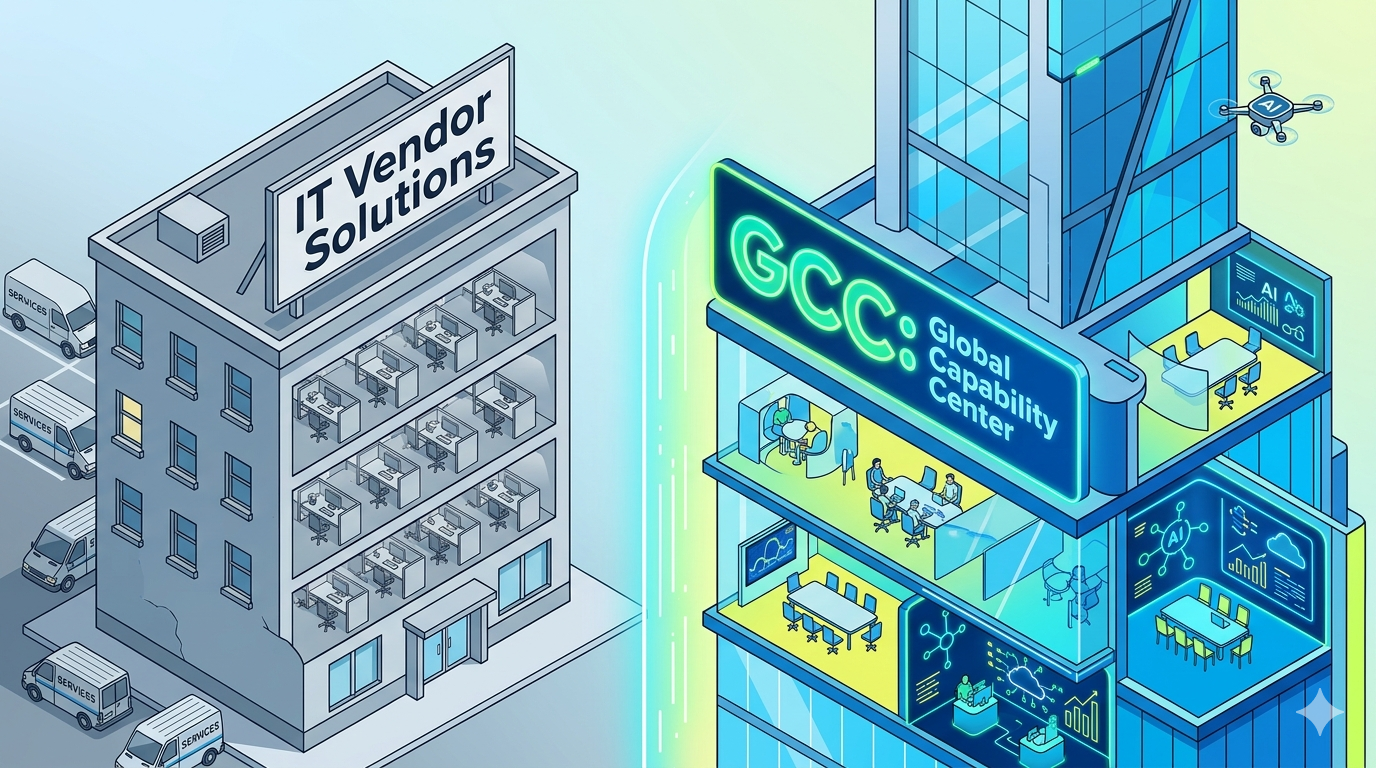
To understand why this trend is permanently reshaping the industry, we must first dismantle a persistent cultural myth: GCCs are not glorified international helpdesks or customer service call centers.
A Global Capability Center is a dedicated, insourced, and wholly-owned offshore subsidiary established by a parent multinational corporation—such as Goldman Sachs, Walmart, JPMorgan Chase, Microsoft, or Nike. Historically referred to as “captives,” these centers operate without a middleman. Instead of outsourcing their software development, predictive data analytics, cybersecurity, or financial compliance workflows to a third-party IT service vendor, global brands build their own dedicated internal divisions right here in India.
The nature of the work being sent to India has undergone a massive qualitative upgrade. Indian teams are no longer just writing basic boilerplate code, managing manual database entries, or running routine system updates. Today, India hosts over 2,117 active GCCs across 3,728 unique operational units, employing more than 2.36 million high-skill professionals. Nearly half of these centers operate at a high maturity stage, meaning they maintain direct, end-to-end ownership of global products, platforms, core AI algorithms, and critical business infrastructure. When a global retail giant processes billions of dollars in transaction data or an international bank deploys an algorithmic trading model, the underlying code is no longer just maintained in India—it is actively architected here.
2. The Core Drivers: Why Traditional IT Services Are Losing Ground
The dramatic divergence in hiring velocity and market clout isn’t an accident. It is the result of structural pressures that have completely broken the traditional outsourcing playbook. For years, massive third-party IT firms grew exponentially by utilizing the “time-and-material” business model—essentially hiring vast armies of generalist tech talent, billing international clients per hour per developer, and keeping a significant bench of unassigned workers ready for the next contract.
Today, that model is under intense strain due to two fundamental shifts in global business strategy:
A. The AI Mandate and IP Protection
As Artificial Intelligence and Generative AI shift from experimental novelties into core operational infrastructure, data security has become the ultimate corporate priority. Global corporations have realized that their proprietary enterprise data—the fuel that trains their specialized AI models—is too valuable and sensitive to be exposed to external third-party tech vendors. To build highly competitive, secure, and sovereign AI frameworks, parent organizations are insisting on absolute data governance. They want their engineering talent working directly within their own corporate security perimeters, bound by identical compliance frameworks. This has triggered an explosion in specialized GCC roles; in fact, over 1,200 centers in India now feature deeply embedded AI and machine learning capabilities, supported by a dedicated talent base of over 250,000 AI professionals.
B. The Corporate Demand for Value over Scale
In an environment marked by global macroeconomic uncertainties, enterprise clients are aggressively trimming multi-million dollar vendor contracts. They are moving away from paying generic service providers for sheer headcount and are instead reallocating those budgets to expand their own captive capabilities. Why pay an external vendor a marked-up premium for 500 engineers when you can open your own GCC in Bengaluru or Hyderabad, hire top-tier talent directly, and retain 100% of the intellectual property and organizational knowledge? This fundamental optimization strategy has caused IT services firms to focus heavily on utilization, productivity, and automation rather than linear headcount expansion, causing their net hiring to drop sharply.
3. The Talent War: Skills-First Hiring and the Premium Pay Gap
The structural divergence between GCCs and IT service providers is perhaps most visible in the current war for Indian tech talent. Because GCCs are tightly integrated into the parent company’s global framework, they treat talent as an innovation asset rather than an operational cost center. This has completely altered the compensation and recruitment standards across major Indian tech hubs.
+-----------------------------------------------------------------------------------+
|                        THE 2026 INDIA TECH WORKFORCE SPLIT                        |
+-----------------------------------------------------------------------------------+
|  METRIC                    | GLOBAL CAPABILITY CENTERS  | IT SERVICES GIANTS      |
+----------------------------+----------------------------+-------------------------+
|  Primary Hiring Focus      | Specialized Niche Skills   | Mass Generalist Lateral |
|  Core Performance Metric   | Business Outcome / Value   | Billable Hours Logged   |
|  Entry-Level SWE Comp      | ₹25 Lakhs – ₹45 Lakhs      | ₹4 Lakhs – ₹8 Lakhs     |
|  Data / AI Talent Pool     | 250,000+ Specialists       | Broad Retraining Model  |
+----------------------------+----------------------------+-------------------------+
As the data illustrates, the financial discrepancy is staggering. While entry-level engineering packages at traditional IT service companies have remained stubbornly plateaued for nearly a decade, global capability centers routinely attract top-tier university graduates with starting packages ranging anywhere from ₹25 Lakhs to ₹45 Lakhs per annum.
Furthermore, recruitment methodologies have shifted toward skills-first talent acquisition. Traditional, rigid job descriptions are being abandoned in favor of flexible skill clustering. Instead of filtering resumes based purely on years of experience or precise formal job titles, modern GCC talent acquisition teams look for specific proficiency clusters across cloud architecture, cybersecurity, product engineering, and advanced data pipelines. Performance tracking has evolved identically: as automated AI agents handle routine maintenance and ticketing workflows, human value is measured by product ownership and measurable business outcomes rather than hours logged or tickets closed.
4. Changing Geographies: Tier-1 Hubs and the Rise of Mini-Metros
The ongoing GCC boom is also driving an extraordinary real-estate and regional economic transformation across the country. Historically, the massive footprint of global capability centers was heavily consolidated within a handful of Tier-1 metros.
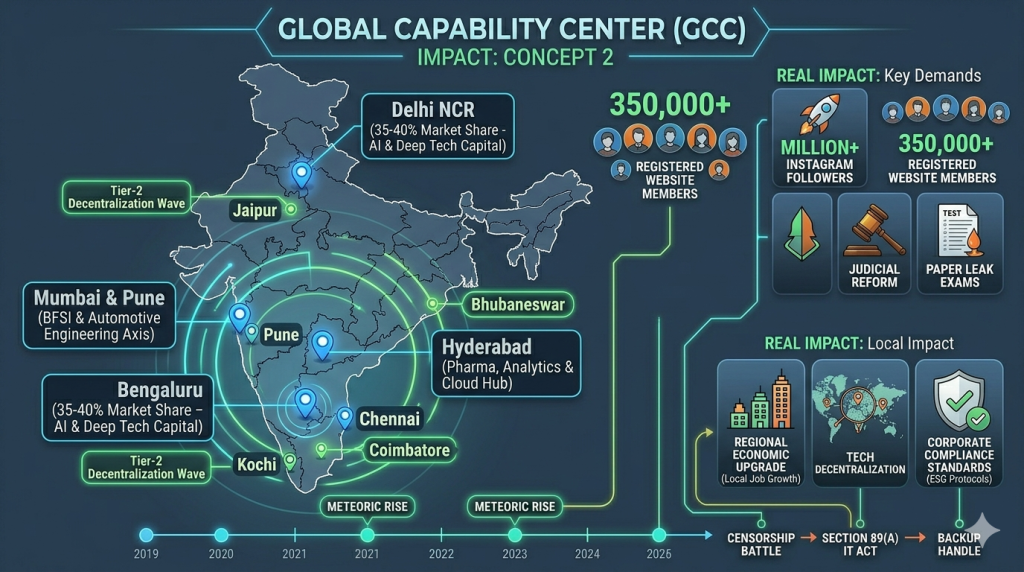
Bengaluru remains the absolute capital of this revolution, holding roughly one-third of India’s entire GCC market value and serving as the primary hub for advanced semiconductor chip design, deep-tech platform engineering, and global software architecture. Hyderabad follows closely as a dominant second, specializing heavily in cloud capabilities, pharmaceutical R&D, and biotechs. Meanwhile, Mumbai and Pune host massive financial services and BFSI hubs managing global risk modeling, regulatory automation, and quantitative treasury systems.
However, as talent retention rates tighten and Grade-A office real estate costs reach record premiums in congested Tier-1 capitals, a vital geographic expansion is taking place. Approximately 40% of established GCCs are now actively expanding their footprint into Tier-2 and Tier-3 cities—a massive leap from a mere 15% just three years ago.
Cities like Coimbatore, Jaipur, Bhubaneswar, Kochi, and Chandigarh are experiencing a historic economic upgrade. These regional mini-metros offer multinationals anywhere from 40% to 60% lower baseline operational expenses and significantly lower employee attrition rates compared to metro hubs. By moving to these secondary hubs, GCCs are introducing global corporate governance standards, robust ESG (Environmental, Social, and Governance) compliance protocols, and world-class cybersecurity infrastructure directly into regional ecosystems, effectively decentralizing India’s tech wealth.
5. ThinkDaily Takeaway: The Career Playbook for the GCC Era
The lessons for the modern Indian professional are unmistakable: The era of generalist, maintenance-driven tech roles is giving way to an era of specialized product ownership.
For decades, the standard career strategy was to build a broad, predictable skill set and ride the wave of massive, linear headcount growth inside a sprawling IT service provider. Today, that playbook is a recipe for career stagnation.
To thrive in the new corporate ecosystem, your primary objective must be to move up the value chain. You need to transition from a mindset of executing assigned tasks to one of managing end-to-end product infrastructure. Whether your focus is data engineering, cross-border financial compliance, cloud migration, or advanced product design, success requires deep domain expertise and real operational execution. Traditional IT service providers are not going to vanish from the landscape overnight, but the crown of economic influence, high-end employment, and technological leadership has officially passed. The future of global enterprise technology is being built from the inside out—and it is being driven directly by India’s soaring Global Capability Centers.