

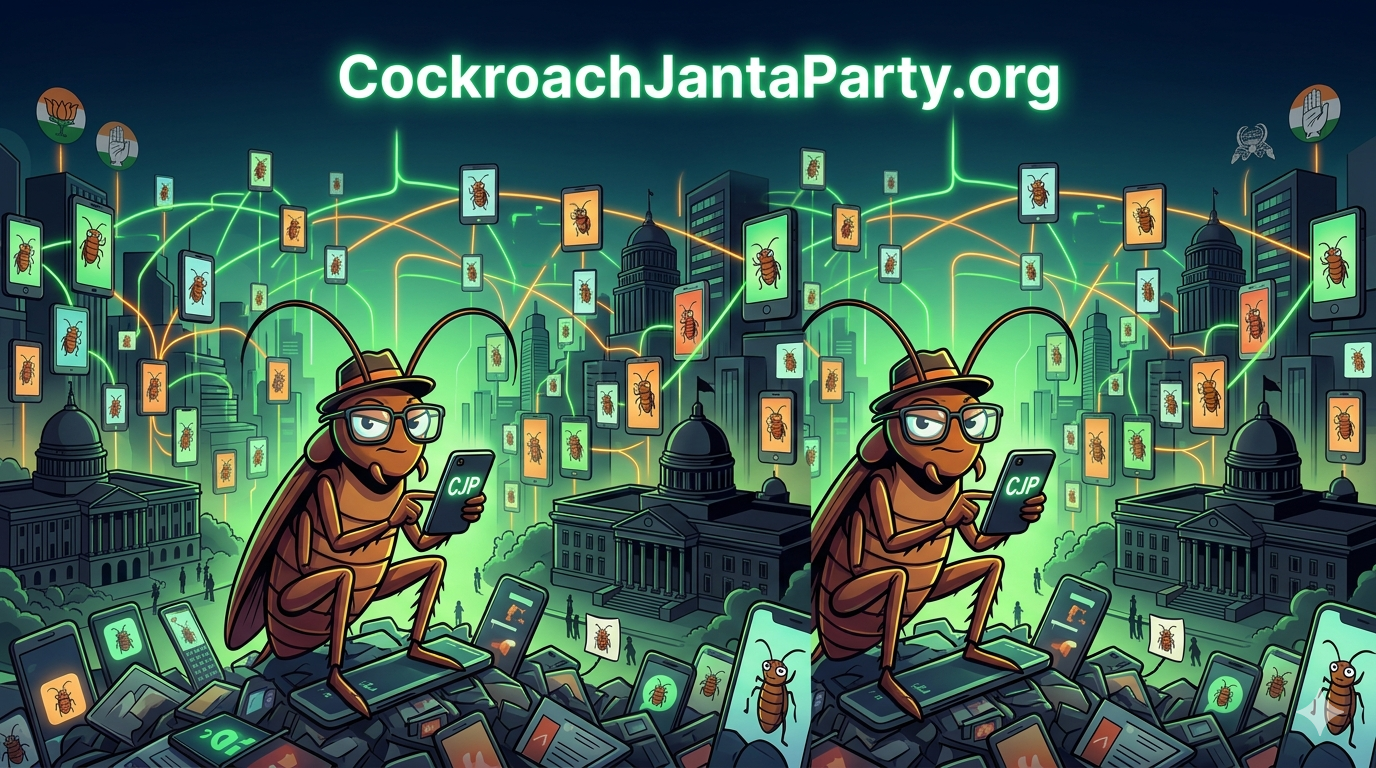
The ‘Cockroach’ Rebellion: How a Satirical Website Beat India’s Biggest Political Parties at Their Own Game
Can a swarm of digital “cockroaches” disrupt the most powerful political machinery in the world?
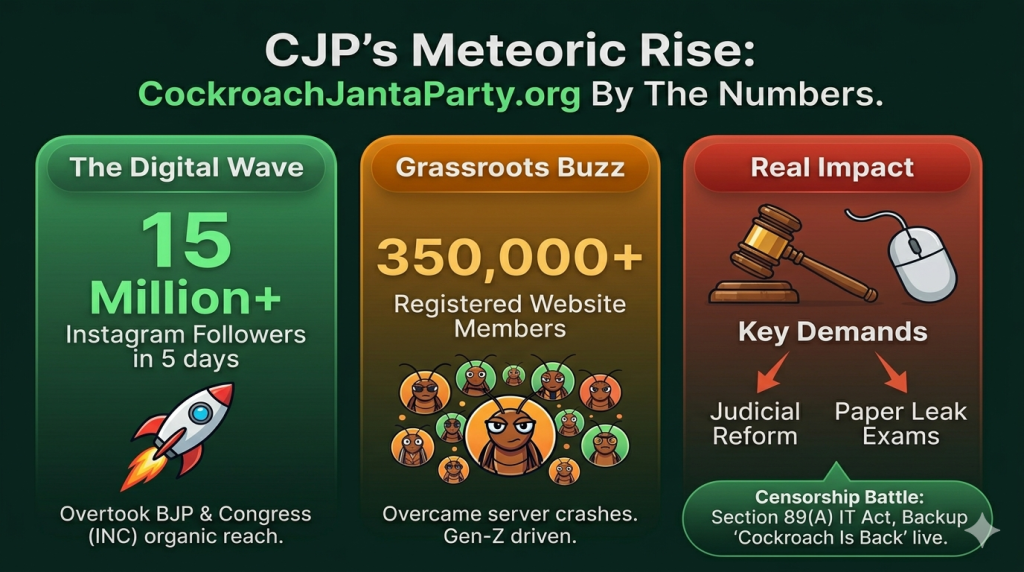
In what is being described as the most meteoric, unprecedented social media phenomenon in Indian internet history, a satirical youth collective operating under the banner of the Cockroach Janta Party (CJP) has achieved the unthinkable. In less than a week, its official portal—cockroachjantaparty.org—and its accompanying social media channels have amassed over 15 million followers on Instagram alone. In doing so, it has officially outpaced the digital follower growth and engagement metrics of both the ruling豪 Bharatiya Janata Party (BJP) and the Indian National Congress (INC).
But behind the relentless stream of internet memes, mock political rallies, and tongue-in-cheek manifestos lies a deep-seated, simmering frustration among India’s youth. What started as a knee-jerk reaction to a perceived insult from the highest echelons of the judiciary has rapidly evolved into a sophisticated anti-establishment movement. It signals a fundamental shift in how the next generation plans to hold power accountable.
1. The Spark: When a Judicial Insult Became a Rallying Cry
The genesis of the Cockroach Janta Party can be traced back to an open court hearing in the Supreme Court of India on May 15, 2026. While presiding over a matter involving online activist groups and public interest litigation, Chief Justice of India (CJI) Surya Kant expressed deep dissatisfaction with the conduct of certain digital platforms. In his spoken remarks, the CJI reportedly compared certain hyper-active, unemployed internet agitators to “cockroaches” and “parasites” who systematically chip away at the credibility of democratic institutions.
While legal experts argued the comments were taken out of context—and targeted fraudulent litigators rather than the general public—the headline spread like wildfire across social media. For millions of young Indians grappling with an intensely competitive job market, recurring structural failures in national competitive exams (such as the NEET paper-leak scandals), and an overall sense of economic stagnation, the word “cockroach” cut exceptionally deep. It felt like an indictment of an entire generation by an insulated establishment.
Sensing the collective wave of digital outrage, Abhijeet Dipke, a 30-year-old political communications strategist and digital activist, chose a path of radical subversion. Rather than issuing a standard press release or organizing a traditional street protest, Dipke weaponized internet culture. On May 16, 2026, he registered the domain and launched the official portal at cockroachjantaparty.org.
The core premise was simple, brilliant, and deeply defiant: “If the establishment views the educated, unemployed youth of this country as cockroaches, then let us embrace it. Remember, cockroaches can survive a nuclear blast. We are un-killable, we are everywhere, and we aren’t going anywhere.”
2. Anatomy of a Digital Phenomenon: Inside CockroachJantaParty.org
Stepping onto the official portal of the Cockroach Janta Party feels like entering a mirror universe of Indian politics. The website is a masterclass in hyper-irony and weaponized satire, specifically designed to appeal to a generation that views traditional political theater with utter cynicism.
The party explicitly defines its identity on its homepage:
“A political front of the youth, by the youth, for the youth. Ideology: Secular – Socialist – Democratic – Lazy.”
The “Membership” Drive
Traditional political parties spend hundreds of crores of rupees running grassroots membership drives. The CJP achieved it using a basic digital form and a heavy dose of self-deprecating humor. To officially register as a “party worker” or “member” through cockroachjantaparty.org, applicants must satisfy a highly specific set of criteria listed on the portal:
- Must be currently unemployed or deeply dissatisfied with their 9-to-5 corporate grind.
- Must possess the ability to be incredibly lazy yet show bursts of hyper-fixated productivity.
- Must be chronically online, with a minimum of 4 hours of screen time daily.
- Must have a proven track record of “professional online ranting.”
Astonishingly, within just five days of the website going live, over 350,000 young Indians formally submitted their details to become registered members of the CJP. The portal’s crashing servers became a badge of honor, shared widely on Reddit and X as proof of the “infestation” spreading.
3. The Satirical Manifesto with a Deadly Serious Core
What prevents the Cockroach Janta Party from being dismissed as a passing internet joke is the clever way its organizers have woven genuine structural demands into their comedic content. Beneath the veneer of absurdism, the CJP manifesto highlights the exact policy failures that traditional political parties routinely sweep under the rug.
Key Satirical Demands:
- The “Anti-Turncoat” Rule: A complete, lifetime election ban for any politician who defects from the party they were elected under to join a rival coalition.
- Judicial Reform: A total ban on post-retirement government appointments or Rajya Sabha seats for Supreme Court and High Court judges, aimed directly at preserving the separation of powers.
- Gender Equity: Immediate implementation of a strict 50% reservation for women across all legislative bodies, moving past the delayed timelines of existing legislation.
- The “Paper Leak” Penalty: Immediate accountability and strict criminal trials for administrative officials found guilty of leaking educational board exam papers, addressing the collective trauma of millions of students affected by recent testing scandals.
- The “Right to Rest”: A legally mandated 4-day work week for all corporate employees, coupled with a national “Unemployment Stipend” funded by a luxury tax on billionaires.
By packaging these structural reforms in a humorous, digestible format, the CJP has done something mainstream policy analysts have failed to do for a decade: they made systemic administrative reform engaging to an 18-year-old scrolling through short-form videos.
4. Going Viral: The 15-Million Instagram Surge
The velocity of the CJP’s growth has completely blindsided traditional political strategists. Within 96 hours of its inception, the party’s official Instagram handle experienced an exponential hockey-stick growth curve, crossing 15 million followers.
To put this in perspective, India’s mainstream political parties spend millions of dollars annually on dedicated IT cells, paid influencers, and targeted ad campaigns to maintain their digital footprints. The CJP surpassed both the BJP (8.7 million) and the Congress (13.3 million) organically using zero-budget, community-generated content.
The movement’s visual language relies heavily on absurdism. Memes featuring giant cockroaches sitting in parliament, mock campaign posters with slogans like “VOTE FOR CJP: Because the options are already garbage,” and deep-fried audio tracks of political speeches have become the dominant currency of Indian social media.
Furthermore, the movement has cleanly transitioned from the digital realm to the physical world. In major urban centers like Bengaluru, Mumbai, and Delhi, groups of youth have begun organizing localized public service initiatives. Dressed in affordable, DIY cockroach costumes, these volunteers have conducted beach clean-ups, assisted in managing traffic bottlenecks, and distributed food to the homeless—all while holding placards that read: “Just a few pests cleaning up the neighborhood.”
5. The Establishment Strikes Back: Section 69(A) and the Tech Battle
As the movement transitioned from a localized joke into a dominant cultural narrative, the Indian political establishment began to view the CJP not as an amusing anomaly, but as a genuine threat to their narrative control. High-profile opposition figures, including Trinamool Congress MP Mahua Moitra and veteran politician Kirti Azad, publicly interacted with the movement online, adding political weight to the viral phenomenon.
The state’s counter-response was swift and heavy-handed. On May 20, 2026, the Ministry of Electronics and Information Technology (MeitY), acting on directives and security briefs from the Intelligence Bureau (IB), invoked Section 69(A) of the Information Technology Act. The order instructed X (formerly Twitter) to immediately withhold the Cockroach Janta Party’s primary handle within the geographical borders of India, citing vague concerns regarding “public order and national security.”
In traditional politics, a government ban or the suspension of an official platform can deal a catastrophic blow to an organization. In the ecosystem of internet culture, however, censorship functions as the ultimate catalyst. It triggers the Streisand Effect—where an attempt to hide or suppress a piece of information flattens all barriers and ensures its absolute proliferation.
Within an hour of the ban, the organizers launched a backup handle titled simply “Cockroach Is Back”. The account’s opening bio read: “You thought you could step on us? Lol. We survive radiation.” The backup account gained over 50,000 followers in a matter of minutes as prominent independent creators, journalists, and everyday internet users amplified the new link in solidarity. The censorship order effectively validated the CJP’s narrative: it proved the establishment was genuinely afraid of a group of internet-savvy youth armed with nothing but smartphones.
6. The ThinkDaily Takeaway: The Era of Hyper-Ironization
The meteoric rise of cockroachjantaparty.org marks a watershed moment for digital culture and political communication in India. It offers a blueprint for how future dissent will likely be structured.
For decades, political protest in India followed a predictable script: street rallies, hunger strikes, blockades, and televised shouting matches. But for Gen Z and young millennials, these traditional formats feel outdated, performative, and profoundly disconnected from their daily realities. This generation doesn’t communicate through press communiqués; they communicate through short-form video hooks, memes, and deep layers of irony.
By leaning into hyper-ironization—the act of taking an insult thrown at you, magnifying it to an absurd degree, and using it as a shield—the CJP has effectively insulated itself from standard political attacks. How does a mainstream political party launch a smear campaign against a group that openly calls themselves “lazy, unemployed cockroaches”? Traditional political attacks require an opponent who takes themselves seriously. When your opponent’s entire brand is based on refusing to take the system seriously, the establishment’s playbook becomes completely useless.
Whether the Cockroach Janta Party remains a fleeting, seasonal internet trend or successfully mutates into a structured, long-term political lobby remains to be seen. But its initial legacy is already secured. CockroachJantaParty.org has proven that in the modern digital landscape, the most potent weapon against institutional apathy isn’t anger—it is unmitigated, un-killable ridicule.