

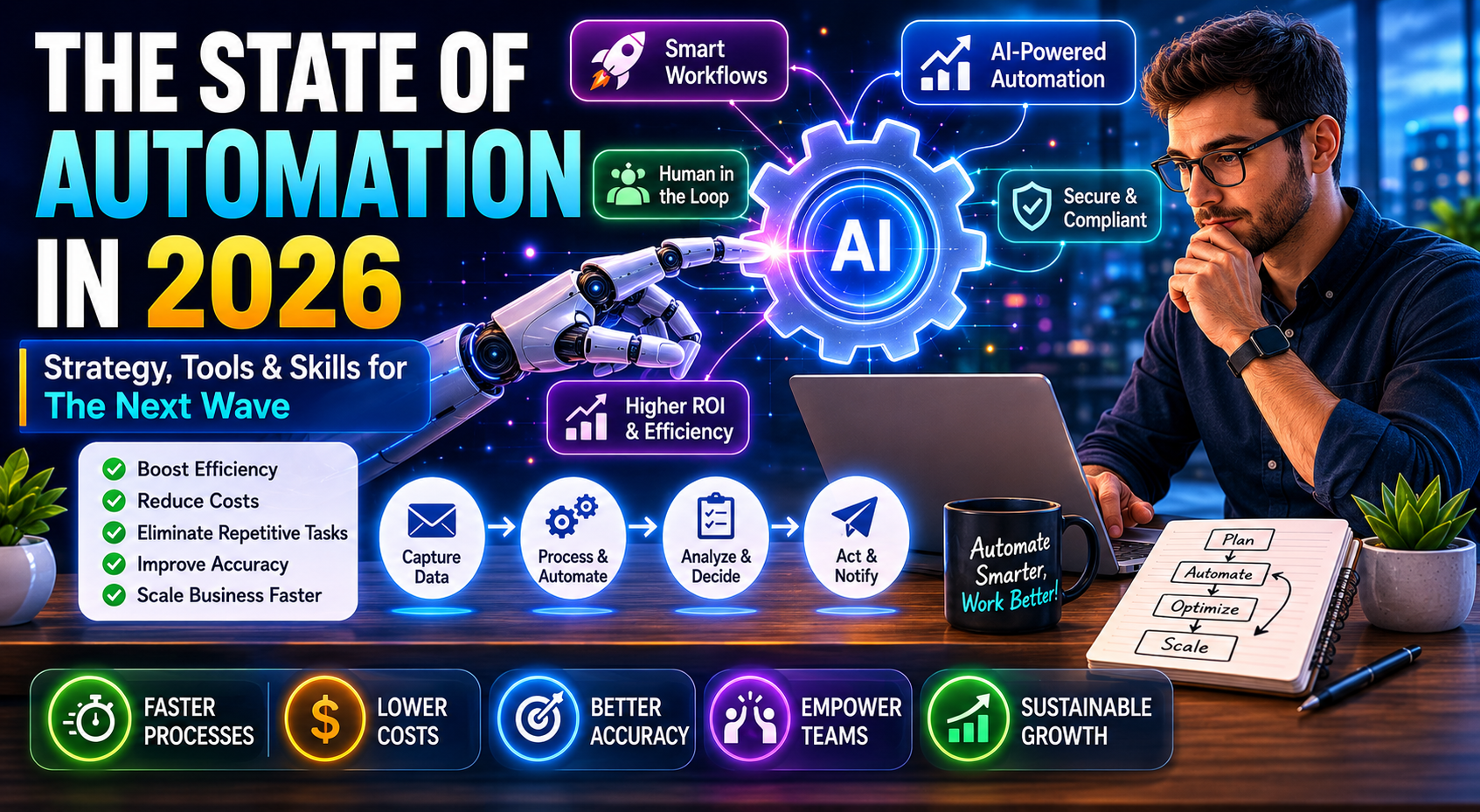
Automation has shifted from a back‑office efficiency play to a core business capability. In 2026, leaders aren’t asking whether to automate—they’re deciding what to automate next, how to orchestrate humans and machines, and how to govern the resulting systems responsibly. This article unpacks where automation delivers value, the most effective tools and patterns, the pitfalls to avoid, and the skills your team needs to compound gains over time.
Why automate now
Three forces make automation non‑negotiable. First, customer expectations for instant, 24/7 responses set a bar that manual teams can’t sustain. Second, the software stack has exploded—organizations stitch together CRMs, data warehouses, billing platforms, and internal tools. Glue work between apps wastes talent. Third, AI has matured enough to handle unstructured inputs (text, images, speech), unlocking use cases that were previously off limits.
The promise is clear: faster cycle times, lower error rates, better compliance, and capacity for higher‑value work. The risk is equally clear: fragmented bots, shadow IT, and brittle workflows that fail silently. The winners treat automation as a product, not a side project.
High‑impact use cases
- Customer operations: Automate tier‑1 support with AI triage that classifies tickets, extracts intent and sentiment, suggests replies, and routes complex cases to specialists. Add SLA timers and auto‑escalations to reduce backlog and response variance.
- Finance and back office: Use robotic process automation (RPA) for invoice ingestion, 3‑way matching, and exception handling. Pair with OCR and machine learning for line‑item extraction and fraud flags. Close the loop by automatically posting to the ledger after approvals.
- Sales and marketing: Trigger personalized nurture sequences when leads meet intent thresholds. Enrich accounts from third‑party data, update CRM fields, and notify owners in the tools they already use. Automate quote generation and e‑signature collection to shrink time‑to‑close.
- IT and security: Automate identity lifecycle (provisioning, access reviews, offboarding) via policy‑as‑code. Monitor configuration drift and trigger remediation. Use playbooks for common incidents to standardize responses and shorten MTTR.
- Data and analytics: Schedule ELT pipelines, automate data quality checks, and surface anomalies to data owners with suggested fixes. Embed reverse ETL to keep operational systems in sync with the warehouse.
- HR and people ops: Standardize onboarding—hardware requests, tool access, mandatory training, and 30‑60‑90 day check‑ins. Automate payroll updates and benefits enrollment via authoritative sources.
Principles for sustainable automation
- Start with outcomes, not tools. Define a measurable target like “reduce first response time by 40%” or “cut days sales outstanding by 10.” Work backwards to the minimum set of automations that move that metric.
- Map the process. A simple swimlane diagram exposes handoffs, delays, and duplications. Automate the critical path first; don’t pave cow paths that should be redesigned.
- Design for exceptions. The happy path is easy. Value appears when the system gracefully handles missing data, policy conflicts, and third‑party outages—with alerts and fallback flows.
- Keep humans in the loop. Identify decision points that warrant review. Provide context, confidence scores, and one‑click approve/deny so humans supervise rather than redo work.
- Version and observe. Treat automations like code. Use version control, change logs, and canary releases. Instrument with metrics (success rates, latency, rework) and alert on regressions.
- Secure by default. Apply least privilege, rotate secrets, and isolate runtime environments. Log data access and redact sensitive fields wherever possible.
Choosing the right tools
The landscape spans three main layers:
- Trigger and orchestration: Event buses and workflow engines kick off jobs on schedule, webhook, or data change. Prioritize tools with idempotency, retries with backoff, and human‑task steps.
- Task execution: RPA handles UI‑level interactions with legacy systems; APIs are preferable for stability. AI components classify, summarize, extract entities, and generate content. Use model gateways for observability and policy.
- Integration and data: Managed connectors reduce maintenance. Prefer push‑based updates where possible to avoid polling storms. Ensure lineage tracking and schema validation to catch breaking changes early.
Low‑code platforms speed delivery for business users but can sprawl without guardrails. A pragmatic approach blends low‑code for simple, local automations and pro‑code for shared, mission‑critical flows. Standardize patterns and component libraries so teams don’t reinvent the wheel.
Measuring ROI
Return on automation is simpler to express than to capture. Build a baseline over two to four weeks: throughput, lead times, error rates, rework, and employee satisfaction. After rollout, track:
- Cycle time reduction: End‑to‑end time from request to completion.
- Quality: Defect rates and escaped errors, especially in finance and compliance contexts.
- Cost per transaction: Hours saved and infrastructure usage.
- Employee experience: Survey friction, context switching, and time spent on creative work.
- Customer experience: CSAT, NPS, resolution time, and first‑contact resolution.
Attribute savings conservatively. Count only stabilized wins that persist after two months. Reinvest 20–30% of gains in reliability, documentation, and enablement.
Governance without gridlock
Good governance accelerates delivery by clearing ambiguity. Define:
- Intake and prioritization: A lightweight form capturing business value, risk, and data sensitivity. Rank by impact and ease.
- Standards: Coding conventions, naming, secrets management, and dependencies. Publish reusable templates for approvals, exception handling, and notifications.
- Reviews: Security and data checks proportional to risk. Fast‑track low‑risk automations; deep‑dive for those touching PII or money movement.
- Access control: Role‑based permissions for design, deploy, and operate. Separate dev, staging, and prod.
- Monitoring and incident response: SLOs for critical workflows, on‑call rotation, and runbooks.
This scaffolding keeps autonomy high while preventing fragile, opaque systems.
Common failure modes
- Automating a broken process: If inputs are inconsistent or policies unclear, automation will amplify chaos.
- Bot sprawl: Dozens of one‑off bots with no ownership or observability. Centralize registries and owners.
- Silent failures: Missing alerts and weak retries lead to undetected data loss. Instrument everything.
- Overfitting to a tool: Choosing a platform first and bending processes to fit it. Let requirements drive selection.
- Ignoring change management: Users blindsided by new flows will invent workarounds. Train, document, and gather feedback.
Skills for the next wave
- Process thinking: Ability to model systems, identify bottlenecks, and balance local vs. global optimization.
- Data literacy: Understanding schemas, quality checks, and basic SQL accelerates troubleshooting.
- Prompt and policy design: For AI components, craft robust prompts, define guardrails, and evaluate outputs.
- Secure automation: Secrets, auth flows, and least‑privilege patterns.
- Product habits: Roadmaps, usage analytics, A/B tests, and a culture of iteration.
Pair these with a clear career path—automation engineer, citizen automator, platform owner—so contributors see growth and accountability.
Getting started in 90 days
- Weeks 1–2: Build your intake form and value framework. Identify three candidate processes with measurable impact.
- Weeks 3–6: Map processes, implement MVP automations, and put basic observability in place. Pilot with a small user group.
- Weeks 7–10: Harden for exceptions, add human‑in‑the‑loop steps, and document. Train affected teams.
- Weeks 11–12: Roll out broadly, set SLOs, and schedule a post‑implementation review. Create a backlog from user feedback.
The goal is not perfection; it’s a repeatable path from idea to reliable automation that compounds over time.
The bottom line
Automation is no longer a bolt‑on efficiency gain. It’s an operating model that blends orchestration, AI, integration, and human judgment. Treat it like a product: pick outcomes, design for exceptions, measure relentlessly, and build shared platforms and skills. Do this well, and you free teams to focus on the uniquely human work that moves the business forward.
Discover more from Think Daily
Subscribe to get the latest posts sent to your email.